KEY:       shows links between the main pages.                      
shows javascript feeds, which give extra facilities. Links going from the Home page to light green pages are omitted.
The site map itself does not provide links. Use the tabs below.
 
   
    Lake District      
   
    The Howgills      
   
    Eden Valley      
      The Dales      

 
Back home    
 

The Pennines.


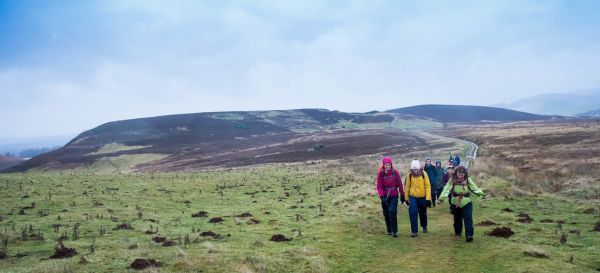
The portion of the Pennines of interest to the Penrith Ramblers are the western faces of the nearby fells forming the eastern boundary to the Eden valley. From Penrith the continuous ridge of the Pennines can easily be seen. Looking from north to south, the following fells regularly receive a visit every few years.
First comes Melmerby Fell at 710 metres, next Cross Fell, the highest in the Pennines at 893 metres and then Great Dunn Fell at 848 metres. This fell has a white radome looking like a giant golf ball on its summit. The radome is used by the Civil Aviation Authority's air traffic control and can be seen from over 40 miles away with the naked eye on a clear day.
Next is Knock Fell at 772 metres, Dufton Fell at 687 metres, Meldon Hill at 767 metres and Mickle Fell at 790 metres. Between Meldon Fell and Mickle Fell runs the Pennine Way long distance path which starts in the Derbyshire Peak Disrict and finishes at Kirk Yetholm just over the border in Scotland. On its way to Dufton, the Pennine Way passes a spectacular ravine known as 'High Cup Nick'. It has sheer rock faces rising 100'. Walks taking in High Cup Nick occur quite often.Then comes Murton, Mickle and Little Fells and Warcop Fell just to the north of Brough.

To the east of Knock Fell flows the River Tees, which descends 200 ft at Cauldron Snout, the highest waterfall in England. About 4 miles futher down stream is High Force, a spectacular moorland waterfall, 70 ft high and the largest waterfall in England.

In the Pennines is Alston, the highest market town in England, with its steep cobbled streets. It lies on the South Tyne and the Pennine way. From Easter to September you can take a trip on The South Tynedale Railway, which runs north west from Alston along the side of the South Tyne for about 3 miles to the village of Kirkhaugh. It is northern England's highest narrow gauge railway. The trains are hauled by preserved steam and diesel engines. Besides taking a trip on the railway, you can become a member of the society and help the railway function perhaps as signal man, guard, loco driver or maintenance of track, carriages or buildings.
At Alston railway station is The Hub, which is a museum and includes vehicular and local history.
Also in Alston is the Gossipgate Gallery, which specialises in displaying the work of contemporary artists and craftspeople from the north of England. The gallery shop is in a converted Congregational church and lies in a quiet backlane 100 yards from the town centre on the way to the Seven Sisters Waterfall. On display are watercolours, prints, ceramics, jewellery, handcrafted silver and glass, wooden bowls, studio glass, textiles and much more.

Roughly 5 miles to the south of Alston is Ashgill Force, with the arch of a bridge carrying the B6277 framing it. Grouse shooting and the Nenthead Mines Heritage Centre, about 5 miles south east of Alston, attract visitors to the area. At the Centre you can take a trip into a lead mine and can discover the way silver, zinc and lead were processed and how the miners of the area lived and worked. There is a gift shop and cafe.

To Top

Thortergill tearooms, Tel 01434 381936, is situated in a wooded valley located some 400 yards off B6277 to Teesdale before Garrigill village near Alston. Besides the tearooms serving homemade food, there are waterfalls and a blacksmith's forge where you can see hand forged items being made.

Romaldkirk is a village in Teesdale, which seems to be in a time warp, having changed very little in the last century. Its church, St Romald's, dating from AD1155, when its nave and north aisle were built, is known as the 'Cathedral of the Dales' even though, strictly, it is now in the North Pennines.

The Village bakery, Melmerby is between Penrith and Alston on the A686. It has a restaurant and shop, both specialising in organic cooking. The shop sells breads and cakes suitable for special diets and organic groceries.

There are no castles actually in the Pennines. To the east however, there is the magnificent mediaeval Raby Castle, with its impressive Baron's Hall, where 700 knights met in 1569 to plot the doomed Rising of the North. Equally striking is the cavernous kitchen, which is virtually unaltered since 1360, when it was built. The reception rooms contain 18th and 19th century furniture, paintings and furnishings, while outside there is a walled garden dating from the mid 18th century containing rose, heather and conifer gardens and majestic trees. Beyond this is a 500 acre deer park containing red and fallow deer. The castle is on the A688, 8 miles NE of the town of Barnard Castle.
In Barnard Castle itself is Bowes Museum, which has paintings by Canaletto, El greco, Goya and Turner, a collection of ceramics and the magical silver swan automaton made in 1773, besides a series of Period Rooms dating from Tudor to Regency times. It is open daily, except for 25th and 26th December and 1st January. Follow the signs off A67 to get there.

Just to the north of the Pennines is Hadrian's wall, built in AD122, linking Carlisle to Newcastle. The wall is a World Heritage Site. Some of the wall and forts are in good order with Housesteads, 5 kms north-east of Bardon Mill, being the most complete Roman Fort in Britain. There you can see the site of barracks, granaries and even Roman soldiers' latrines, with a good stretch of wall still visible. Just 3 kms south west is Vindolanda, where excavations are still in progress.

To Top